
 Home
HomeWeight Scale Accuracy: Everything You Need to Know for Importers and Distributors
 May 15,2026
 Unique Scales
Choosing the wrong Weight Scale Accuracy can lead to returns, customer complaints, and even the bankruptcy of your business. For instance, if you choose an ordinary smart scale to enter the market of high-end chain gyms, this will definitely affect your customer satisfaction and brand reputation. In this article today, we will detail the Accuracy of each type of scale and how to choose the appropriate Accuracy for your business.
Why do you have to pay attention to the accuracy of the Weight Scale?
Weighing Scale: The Difference Between Accuracy and Precision
Weighing Scale Accuracy: This refers to how accurate the measurement results provided by the weighing scale are, and how closely they match the actual values of weight, body fat, heart rate, water content, etc.
Weight Scale Precision: Multiple measurements are required. If the readings are taken repeatedly, will the data fluctuate? How stable is the reading of the intelligent scale?
For you, the after-sales returns, negative reviews and customer losses of the smart bathroom are all direct losses of profits, and even lead to the failure of the business.
Only when the accuracy of the intelligent scale ensures the authenticity of the data and the precision of multiple measurements guarantees stability can it reduce post-sale disputes, maintain the reputation of your users or end consumers, and be conducive to long-term repeat purchases and returning customers.
What are the main factors that affect the accuracy of the weighing scale?
1.High-accuracy sensor
The sensor is the foundation for the accuracy and stability of our bathroom scales.
Its material, strain gauge, linear sensitivity, temperature and humidity resistance, assembly process, uneven elasticity, and poor workmanship, all of these can determine whether a scale is accurate, stable, durable, and are also the core components you should focus on when selecting and controlling the quality.
2. Environmental Factors
- Temperature: Since the inner part of the scale is composed of metal strain gauges and circuits, as the temperature rises, the metal expands and the resistance increases; when the temperature drops, the metal contracts and the resistance decreases. This directly affects the electrical resistance output of the sensor, causing the weight or reading zero point to drift and resulting in errors. It is recommended to choose an intelligent scale with high accuracy sensors.
- Humidity: It is the "invisible killer" of electronic scales. If it is too humid, it will cause the internal circuits to get damp, leak electricity, and even gradually break down; if it is too dry, it is prone to causing static electricity. Precautionary measures must be taken in advance.
- Ground Flatness: The intelligent scale must be placed on a "hard, flat, and stable" surface; a soft or uneven surface will definitely result in inaccurate measurement data. If your users receive the body fat scale and due to an uneven ground or improper use, they obtain data with large errors, they will directly give a bad review.
3. Calibration method
- Single-point calibration: Use a fixed weight of 50kg/60kg as the standard to level the zero point and coefficients, and conduct a one-time baseline calibration. This is suitable for low-end ordinary Bluetooth body weight scales.
- Multi-point calibration: Use multiple different weight weights to conduct segmented calibration, such as 20kg, 40kg, 60kg, 80kg, 100kg, and individually calibrate and correct each of the light, medium, and heavy intervals. This can effectively reduce errors and has better stability. It is suitable for high-precision body fat scales, gym scales, and body composition measurement devices for the whole body.
- Automatic calibration: The scale has its own calibration function. That is, after each power-on, restart, or leveling, it automatically resets to zero and corrects the initial baseline.
- User calibration: Whenever the user is not using the scale for a long time, moves to a different location, or changes the battery, the user steps on the scale once, and the intelligent Bluetooth scale will automatically re-identify the zero point and baseline, completing self-calibration.
4. Power stability
During the entire weighing process of the Bluetooth WiFi scale, the voltage and current of the battery or power supply must remain stable without fluctuations, so that the circuit and sensors can function properly. If the voltage and current output of the power supply are unstable, the intelligent scale will immediately have inaccurate data or skip numbers. This is an essential hidden core configuration that you must pay attention to when choosing the product.
The differences between weighing scales with different accuracies
|
|
|
|
|
|
|
|
|
|
|
|
|
|
|
|
|
|
|
How to Choose Right Accurate Weighing Scale for Your Market?
When choosing an accurate weighing scale, you cannot only focus on its accuracy - you also need to consider whether the product matches your target market, after-sales service, market entry and regulations.
1. According to usage scenarios
1) Ordinary daily household
The precision requirement is generally moderate, with an error of ±0.1 to 0.2 kg in division, single-point / simple multi-point calibration. The product price is sensitive, and you mainly focus on the stability and ease of use of the scale.
2) Home fitness for weight loss and weight management with detailed precision
It must have ±0.1 kg ultra-high precision, multi-point full-range calibration, 4 independent sensors, and extremely small repeatability error.
3) Gyms, yoga chain stores, medical clinics, community health facilities
The precision requirement is high, ±0.05 kg or higher. It has advantages such as automatic online calibration, super strong power voltage stabilization, resistance to uneven ground, and long-term no drift in numbers. It can track the training effects of weight loss and muscle gain, and view body data reports. You need to focus on the repeatability, stability, and professional certifications such as CE, FCC, and RoHS of the scale.
4) Amazon/Independent websites/Brand importers
2. Different markets have different precision standards:
1) European market:
- Accuracy: In the European market, the requirement for precision is a division of 0.1kg, with the full-scale error being ≤ ±0.1kg and the repeatability being ≤ 0.1kg.
- Hardware: It is required to have 4 high-precision sensors, supporting multi-point segmented calibration and stable power supply.
- Environment: The readings should remain stable and not drift in high-temperature, low-temperature or humid environments.
- Certification: It must have certificates such as CE, LVD, EMC, MID for measurement compliance.
- Suitability: For high-end home management, fitness and weight loss, as well as commercial and supermarket brands.
2) North American market
- Accuracy: The requirement for precision in the North American market is within ±0.1 to 0.2 kg;
- User characteristics: Due to the majority of users being of large weight, a large range of 180–200 kg is given priority consideration.
- Hardware: It is required to have high-end sensors, stable power supply, and automatic zero-point calibration functions.
- Certification: It must have FCC and Bluetooth certifications, and for commercial and retail use, NTEP measurement certification must be met.
3) Southeast Asian market
- Accuracy: The accuracy requirement for the Southeast Asian market is within ±0.2 to 0.3 kg.
- Hardware: It should have basic functions such as single-point calibration, ordinary sensors, and stable power supply and voltage regulation.
- Environment: It needs to meet environmental conditions such as high temperature, high humidity, moisture-proof, and voltage fluctuation-proof, and the reading should be stable without drifting.
- Suitability: Suitable for large-scale sales on e-commerce platforms and local supermarket retail.
4) Middle East market
- Accuracy: The accuracy requirement in the Middle East market is within ±0.2 to 0.3 kg.
- Hardware: It must have high-temperature power supply stability, battery durability, resistance to voltage instability, and protection against dust and moisture.
- Population characteristics: Due to the majority of the population being of large weight, priority is given to a large range of around 200 kg.
5) Japan and South Korea market
- Accuracy: The requirements for precision in the Japanese and Korean markets range from ±0.1kg to ±0.2kg.
- Hardware: It is necessary to have multiple calibrations, four sensors, and basic functions such as stable power supply and voltage regulation.
- Certification: For sales in South Korea, a KC certification is mandatory.
You can choose the appropriate precision for the target market of the intelligent body fat scale, which can effectively avoid user returns and complaints.
FAQ
1.Which type of weighing scale is the most accurate for both household and commercial use?
- Family: 4-electrode intelligent body fat scale, multi-point calibration, Bluetooth and WiFi dual mode, suitable for daily health management.
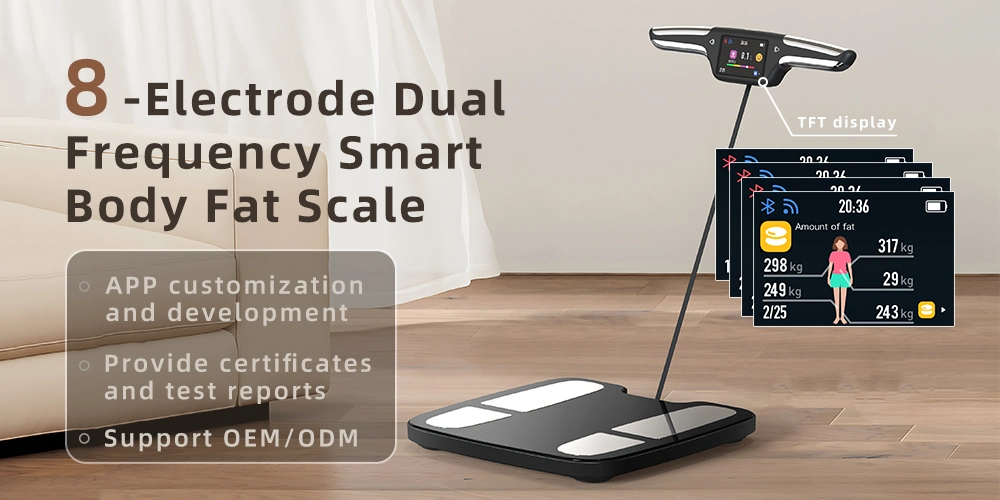
- Business: High-end 8-electrode body fat scale, with 4 electrodes on the surface and 4 electrodes on the handle, using BIA technology, it can measure 57 body data indicators. Fully automatic machine calibration, higher accuracy, more stability, and greater durability, suitable for high-frequency professional places such as gyms and yoga studios.
2. Before importing, how can I check the accuracy of the weighing scale?
- First, measure the accuracy, linearity and repeatability of the full range using standard weights.
- Observe its actual usage environment by simulating situations such as ground flatness, high/low temperatures, humidity, low power, etc.
- Conduct measurements with different real people and different weights.
- Conduct batch sampling instead of just looking at the sample.
- Observe whether the zero point will automatically drift.
By doing all these, you can eliminate problems such as inaccurate measurement, jumping numbers, and poor stability, and avoid situations where customers return the weight scale, leave negative reviews, or even suffer losses after purchasing it.
3. Why do the measurement results of some weighing scales sometimes vary?
- Poor sensor quality
- Inadequate calibration
- Uneven ground
- Environmental disturbances such as high/low temperatures and high/low humidity
- Unstable power supply
- Posture, diet and changes in body's own moisture levels
These five factors can cause inconsistent measurement results of the weighing scale.
4. In order to ensure the accuracy of the measurement, what certifications or standards should I look for?
The manufacturer must possess: ISO9001, ISO13485, BSCI, CE, RoHS, FCC, Telec, BQB, etc. certifications, which meet the requirements for international market entry.
5. How often should the weighing scale be calibrated to ensure the accuracy of the measurements?
Daily use at home: Normally, calibrate once every 3 to 6 months; for situations such as moving, relocation, battery replacement, or abnormal readings, calibrate immediately by yourself.
In commercial settings like gyms: Calibrate once a month; for high-frequency usage areas, calibrate every two weeks.
Our smart body fat scale comes with automatic calibration. Just place it flat and use it normally.
Obtain your body fat scale from Unique Scales Company
Unique Scales Company designs smart weight scales, body fat scales, body composition analyzers, etc. for home health management, global fitness chains, medical health monitoring, and brands such as Amazon/Shopify. Our smart weight scales offer comprehensive customized services via Bluetooth/WiFi/UI/SDK/API/APP mini-programs. Please contact us and explain your requirements to us. We will provide you with a solution that fully meets your factory's needs in terms of high accuracy and reliability.