
 Home
Home4 Types of Weight Scales You Should Know Today
 May 13,2026
 Unique Scales
Choosing the wrong type of weight scale can lead to reduced profits, stock buildup, and even the ruin of your business. For instance, if you choose a basic digital scale to enter your high-profit market, it will definitely result in slow sales and a large amount of stock buildup. In this article today, we will teach you in detail about each type of weight scale and how to choose the right type for your business.
Why Weight Scales Types Selction Matters?
Currently, there are four types of weighing scales: Digital scale, Smart scale, Body fat scale, and Body composition analyzers. It depends on your market demand and business model.
Types of Weight Scales
1#Digital scale
It is an intelligent scale that uses induction high-precision sensors for weighing, and displays the weight figures on a high-definition digital screen.
Due to its wide range of product types, low cost, low profit, simple basic functions, and a large number of similar styles, there is intense competition in the industry.
It is suitable for wholesale for large quantities, Amazon cross-border distribution, wholesale through supermarket channels, and platform best-selling impulse sales models.
2#Smart scale
Based on digital weighing technology, it is equipped with both Bluetooth and WiFi modes, and features BIA bioimpedance resistance technology. It can connect with fitness apps to update data in real time and achieve long-term data tracking.
It features multi-user management identification, automatic data synchronization, health data trend analysis, etc. Its market demand is also on the rise, with high user acceptance. It can be fully customized through OEM/ODM methods, enabling differentiated competition in terms of branding, functionality and intelligence at the mid-to-high end level.
3#Body fat scale
By using high-precision sensors, through BIA technology and combined with body fat algorithms, it is possible to measure a total of 25 to 57 professional body data indicators such as weight, body fat percentage, and heart rate. It is further divided into 4-electrode body fat scale and 8-electrode smart body fat scale.
4-electrode body fat scale: The surface of this scale has four electrodes. It can measure 25 body data indicators such as body fat percentage, BMI, water content, and muscle mass. It mainly measures lower body data by passing a weak safe current from the sole of the foot to the lower body in a circular manner, while upper body data is estimated through algorithms and its accuracy is not as precise as that of the 8-electrode body fat scale. It is suitable for supermarket promotions, low-price sales to increase volume, and is the entry-level model of body fat scales.
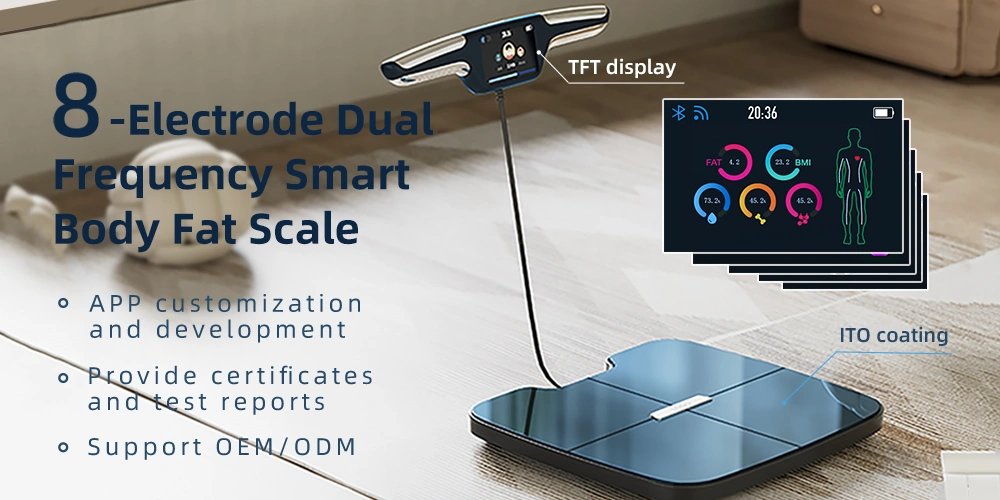
8 Electrode Body Fat Scale: A high-precision sensor body fat measuring device. There are 4 electrodes on the scale surface and 4 electrodes on the handle, forming a closed-loop system covering the entire body. It can measure 57 body data indicators such as weight, body fat, BMI, and muscle mass. Its measurement accuracy is higher and the data is more stable. It also supports real-time updates in dual-mode Bluetooth and Wi-Fi, and can generate printable reports of body composition. Its cost is higher, suitable for brands to offer high-end premiums, and applicable to specific groups such as fitness and shaping.
4#Body composition analyzers
Vertical Bioimpedance Scale: Utilizing the same multi-frequency BIA (Bioelectrical Impedance Analysis) principle, it supports multi-user identification and full-body segmental analysis. It can measure up to 57 body data indicators, including body fat, muscle, water, bone mass, basal metabolism, visceral fat, protein, and other multiple health indicators throughout the body. It also has Bluetooth/WiFi dual connection capabilities and has a correlation of up to 98.7% with DEXA. It is suitable for high-profit markets. Suitable for purchasers and distributors of high-end gyms, health checkup centers, beauty salons, elderly care institutions, etc.
Difference Between Different Type of Weight Scale
|
|
|
|
|
|
|
|
|
|
|
|
|
|
|
|
|
|
|
|
|
|
|
|
|
|
|
|
|
|
|
|
|
|
|
How to Select The Right Weight Scale for Your Application
When choosing the right weighing scale, you should not only consider its functions, but also assess whether the product is compatible with your target market, pricing strategy, and business model.
- Market demand
Digital Scale: Suitable for the general market, can be used for wholesale, supermarkets, and low-price e-commerce platforms;
Smart Scale/Body Fat Scale: Suitable for fitness/weight loss groups, health management users, suitable for the mid-to-high-end market, it is easier to sell and can achieve large-scale production;
Body Composition Analyzer: Suitable for fitness equipment channels, medical institutions, health management centers, suitable for the high-end market;
- Profit margin
The body composition scale has the highest accuracy and the most complex functions, thus it has the highest profit margin and can be used in fitness or medical clinics, etc.
Secondly, there are smart scales and body fat scales. They can be customized with apps, have dual modes of Bluetooth and WiFi, and can measure body fat, water content, and heart rate. They can also be applicable in gyms, fat reduction centers, etc.
Digital Scale is the most basic type and can be used as a daily household scale.
- Degree of Competition
1)Digital Scale: Highly competitive, suitable for low-price sales in supermarkets, with a target audience of global household users;
2)Smart Scale/Body Fat Scale: Moderate, a blue ocean market, suitable for fitness chain stores, yoga studios, etc., for those who need basic health management;
3)Body Composition Analyzer: Small niche market, with little competition, can be a high-profit market with differentiated competitiveness, suitable for commercial venues such as high-end fitness places, pharmacies, etc.
From this, it can be seen that if you sell the basic type of digital scales with such a highly competitive market, you can only adopt a relatively low-price pricing strategy; while the smart scales and body composition analysis products with differentiated competitiveness can better enter the market.
FAQ
1. What is the difference between 4-electrode and 8-electrode body fat scales?
4 Electrode body fat scale: It measures the data of the lower body through a weak safe current, while the upper body data is estimated by an algorithm.
8 Electrode Body Fat Scale: The four electrodes on the weighing surface come into contact with the feet, and the hands hold the four electrodes on the handle, forming a closed-loop throughout the body and measuring the impedance values of the entire body in segments.
Data Dimension: The 4 electrodes can measure 25 indicators; the 8 electrodes can measure 57 indicators.
Accuracy: The accuracy of the 8-electrode system is higher than that of the 4-electrode system.
2. Which type of weighing scale is the most accurate?
Body Composition Analyzer: Measuring in segments using 3-frequency BIA technology, it has the highest accuracy and has a correlation of up to 98.7% with DEXA.
8. Electrical body fat scale: Measured using dual-frequency BIA technology, its accuracy is slightly lower than that of body composition analyzers.
4. Electrode body fat scale: Using single-frequency BIA technology, it only measures data for the lower body. The upper body data is estimated, so its accuracy is lower than that of the 8-electrode intelligent scale.
Ordinary digital scale: It can only measure weight, but cannot measure body fat, fat percentage, heart rate, etc. These body data indicators. Therefore, its accuracy is the lowest.
3. When choosing the type of weighing scale, what factors should I take into consideration?
What you should consider are:
1)Whether to only measure weight?
Measuring only weight: Digital scale;
Measuring body fat and other physical data: Smart scale, body fat scale and Body Composition Analyzer;
2)Accuracy
3) Bluetooth and WiFi
Bluetooth: Low cost, energy-efficient;
WiFi: Automatically synchronizes data, a bit more expensive;
4) Target users and application scenarios
Home management: Smart scale
Fitness/Commercial venues: Body fat scale and Body Composition Analyzer
5) Whether it supports SDK/API compatibility integration
Digital scale: Not supported
Smart scale/Body fat scale/BIA scale: Supported
6) Budget and Positioning
Low-end mass production: Digital scale
Mid-to-high end: Smart scale / Body fat scale
High-end commercial: Bioimpedance Scale
4. For commercial use or resale operations, which type of weighing scale is the most suitable?
Smart Scale / Body Fat Scale: Compatible with APP, featuring dual modes of Bluetooth and WiFi, capable of measuring 25-57 body data indicators, with a reasonable price. It is a must-have for families worldwide, having the largest market demand. It is the most suitable choice for starting a business.
5. Which type of weighing scale has the highest profit margin?
The Body Composition Analyzer has the highest profit margin; followed by the 8-electrode high-end body fat scale.
The reason is: It supports multi-frequency BIA technology, allowing for segmented measurements. The body fat algorithm has a high barrier and a strong premium, with little competition.
Sales channels: gyms, health checkup centers, pharmacies, high-end personal training venues.
Obtain your customized smart scale from Unique Scales Company
Unique Scales Company designs smart scales with Bluetooth, body fat scale, weight scale, etc., for home health management, global fitness venues, medical health monitoring, and brands such as Amazon/Shopify. Our intelligent weight scale offers comprehensive customization services including Bluetooth/WiFi/UI/SDK/API/APP mini-program. Please contact us and explain your requirements to us. We will provide you with a solution that fully meets your factory's requirements in terms of efficiency and reliability.