
 Home
HomeBody Composition Scale Accuracy: Matters You Should Know Before Purchasing
 May 21,2026
 Unique Scales
In the global health and smart home market, the demand for body fat scales is continuously increasing, and the accuracy of body composition scales directly determines the market performance of the products. Low accuracy of smart scales can lead to customer complaints, high return rates, inventory overstock, and even affect your brand reputation. In this article today, we will elaborate on the key factors of body fat scale accuracy, the comparison of market types, and how to choose the appropriate Accuracy for your business.
What is the accuracy of the body composition scale?
Accuracy of body composition scale measurement: This refers to the 57 body composition indicators that can be measured through the 8 electrodes of the smart body fat scale, combined with the body fat algorithm based on bioelectrical impedance (BIA) technology, including weight, body fat percentage, muscle mass, fat percentage, BMI, water percentage, bone mass, and heart rate. The degree of error in the correlation between these measured values and the actual and true body indicators of DEXA is the core technical indicator for evaluating the detection results of body composition analyzers.
The 5 main factors that affect the accuracy of smart measurement
- Number of electrodes: There are 4 electrodes, 8 electrodes, and upright handle-type electrodes respectively. Generally speaking, the more electrodes are used, the larger the measurement area covering the body will be, and the more stable the measurement results will be.
- Bioimpedance-based fat estimation algorithm: Through the bioimpedance (BIA) technology, different body fat algorithms handle the processing of water, age, gender, and body proportions differently, and as a result, the Body data indicators obtained will also vary.
- Sensor quality: The sensors used are of low cost, and their accuracy is susceptible to the influence of temperature, humidity and the operating environment.
- Calibration mechanism: When purchasing intelligent body fat scales in bulk, it is advisable to choose calibrated models first. This ensures consistent measurement data for the entire batch of products, maintains stable performance over the long term, and reduces the problem of data deviations in product after-sales services. Using factory calibration results in some scales being calibrated accurately and some not, leading to more after-sales issues.
- Instruction for Use: If the user's feet or hands do not make full contact, it will also affect the measurement results.
Why is the accuracy of the body composition scale so important?
Firstly, a highly accurate smart scale can ensure stable and reliable measurement results, reducing the return rate of products at your retail end, minimizing customer after-sales complaints, eliminating the need for transportation losses, and avoiding stockpile and accumulation of goods. It also enhances your user experience and brand reputation. On the contrary, a low-precision smart scale is the opposite. Due to inaccurate data, the buyer experience is poor, which can lead to high return rates and high negative reviews, causing inventory accumulation, and in the long run, damaging the brand reputation and even affecting the brand's credibility.
Secondly, when conducting foreign trade exports, the overseas market must have the following certifications: ISO9001, ISO13485, CE, RoHS, FCC, etc. These certifications must be obtained to meet international export standards. For some countries, such as Japan, these certifications have strict requirements for measurement accuracy. Only when the accuracy is up to standard can the goods be smoothly cleared for shipment, and there will be no situations like products being detained or not being able to be listed for sale.
Finally, accuracy is also the core advantage of your smart scale. A high-accuracy body fat scale can be promoted as the main selling point, creating a gap with the low-priced products on the market that have poor accuracy. This will enable you to easily enter the mid-to-high-end market and increase your product sales and profit margin.
Purchase suggestion based on the Body Composition Scale Accuracy type
|
|
|
|
|
|
|
|
|
|
|
|
|
|
|
|
How to Choose Right Accurate Body Composition Scale for Your Market?
Different types of body fat scales vary significantly in terms of accuracy and sales performance. When choosing a product, you need to pay attention to the following key factors:
Number of electrodes:
4-electrode body fat scale mainly measures lower body data indicators through foot electrodes, while upper body data can only be estimated, with limited accuracy. It can measure 25 body data indicators and is suitable for entry-level users.
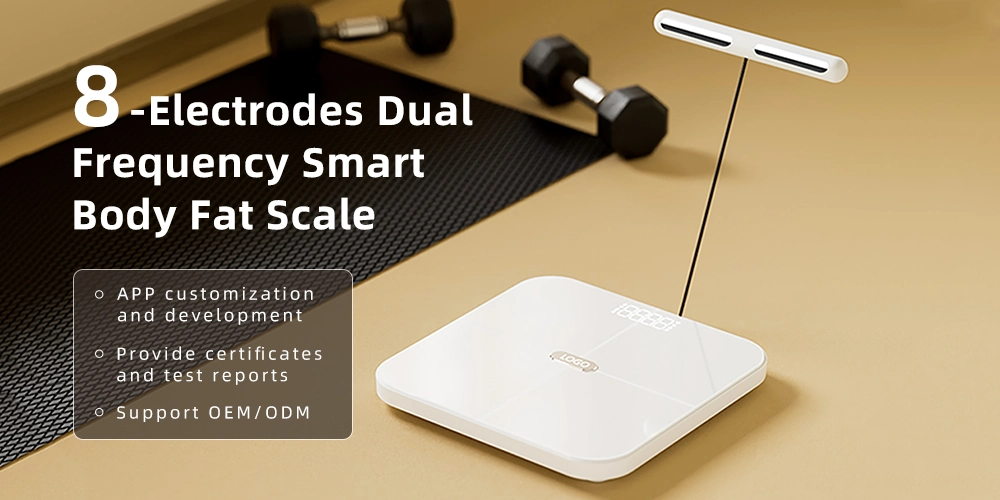
8-electrode body fat scale can measure the overall electrical impedance of the body, with higher accuracy. It can measure 57 body data indicators and is more suitable for the mid-to-high-end market.
Algorithm stability:
Different brands of algorithms have varying adaptability to users' body types, ages, and exercise conditions.
An algorithm with stable accuracy can ensure data consistency and repeatability, reducing the return rate and complaint rate at the retail level.
Batch consistency:
When purchasing intelligent scales in bulk, the measurement consistency of each batch of products determines the risks in the later product after-sales process.
It is recommended to choose manufacturers that can provide batch sampling inspection data and stable production records.
Certification and test data:
A high-accuracy body fat scale should have third-party certifications (CE, FCC, ISO) and a comparison test report showing its correlation with DEXA data.
This ensures that the product complies with international export standards and enhances its credibility.
Therefore, when choosing a body fat scale, one should take into account the number of electrodes, algorithm stability, batch consistency, as well as certifications and experimental data. This approach can not only reduce the risks of returns and after-sales services, but also enhance the core competitiveness in the market.
FAQ
1.For accurate body composition scales targeting the international market, what certifications should they possess?
The following certifications should be obtained: ISO9001, ISO13485, BSCI, CE, RoHS, FCC, Telec and BQB, etc. They must comply with international export standards.
2.How can OEM or ODM customizations affect scale accuracy?
For common OEM and ODM orders, such as custom brand logos, packaging, surface colors, UI, and adjustments to applications and brand information, these are all surface-level changes. Meanwhile, the original factory precision standards and body fat test data remain unchanged, so the measurement stability and consistency of the products will not be affected in any way.
Only by making special adjustments to ODM can its accuracy be changed. For instance, altering the sensor configuration, modifying the internal calibration parameters, adjusting the weighing range, or rewriting the core data algorithm will directly result in inaccurate measurement data and inconsistent batch accuracy.
While meeting the personalized brand requirements of our customers, we will ensure that each scale in the batch orders has stable accuracy, no data deviations, and fully complies with international export certification requirements. This will avoid potential problems such as after-sales issues due to inaccurate data and risks such as customs inspection failures.
3.Do digital weighing scales and smart body composition scales have any differences in measurement accuracy?
There is a difference.
Digital scale: Only measures weight, but cannot measure various body data indicators.
Smart body composition scale: Not only measures weight, but also accurately measures body fat, water content, muscle mass, BMI, etc. It also has a calibration function and has good data stability.
4.What are the different requirements for the accuracy of high-end and mid-range body composition scales?
Mid-range model: Suitable for daily household use. It has a small weight error and can measure 25 data indicators such as body fat, water content, and muscle mass. The requirement for long-term stability is not high. Just undergoing factory calibration is sufficient. Once it meets the basic certification requirements of the exporting country, it can be shipped.
Premium Edition: Its accuracy standards are even more stringent. The 57 body data indicators must closely match the actual values. It must be equipped with automatic calibration. It will not deviate in data even when used for a long time or in environments with significant temperature differences. The accuracy of the entire batch of products is uniform, strictly adhering to the certification standards of the overseas high-end market. It is suitable for long-term sales by brands such as fitness and pharmacies.
5.What reports or documents should the supplier provide to prove the accuracy of the body fat scale?
These materials need to be provided to prove the measurement accuracy of the body fat scale:
- Product accuracy test report, stating the error ranges for various data such as weight and body fat.
- Factory calibration and stability test documents
- Relevant compliance certification certificates such as CE, FCC, RoHS, and ISO
- Batch Outbound Quality Inspection Record Form
- Sensor and core hardware qualification documents
- The measured and compared data report proves that the values are in line with the actual human body indicators.
Obtain Your Body Composition Scale from Unique Scales Company
Unique Scales has designed products such as smart scales, body fat scales, and body composition scales, which are used for home health management, global fitness chains, medical health monitoring, and brands like Amazon/Shopify. Our intelligent body composition analyzer features three-frequency measurement, dual-mode WiFi and Bluetooth, BIA technology, multi-user automatic identification, and provides comprehensive customization services, including Bluetooth/wireless network/user interface/software development kit/application mini-program, etc. Please contact us to inform us of your requirements.