
 Home
HomeBody Fat Scale Technology: How to Choose the Right BIA Solution for Your Product
 Sep 04,2026
 Unique Scales
Choosing a body fat scale technology starts with a few practical decisions: the BIA measurement method, electrode configuration, required measurement capabilities, and connectivity requirements. Does the body fat scale need to be integrated with Bluetooth, Wi-Fi or a third-party platform?
All these factors will determine the hardware configuration, software requirements, development costs and the final positioning of the product. This guide will provide detailed information on the main technologies and help you select the most suitable BIA technology solution for your product based on your product requirements and target market.
What Is Body Fat Scale Technology?
Body fat scale technology estimates body composition through bioelectrical impedance (BIA), weight measurement, user profile information, and calculation algorithms. Depending on the hardware and software configuration, the body fat scale can provide 25 to 57 body composition indicators.
What Is BIA Technology?
BIA (Bioelectrical Impedance Analysis) measures the body's electrical impedance by applying a safe, low-level electrical signal. The impedance result is then used with user information and a calculation model to estimate body composition.
Direct Measurement
Depending on the product configuration, a body fat scale directly measures:
- Body weight
- Electrical impedance
Estimated Metrics
The smart body fat scale, combined with impedance measurement data, user information, and body fat algorithms, can estimate 25-57 body composition metrics, including:
- Body fat percentage
- Fat mass
- Muscle mass
- Body water content
- Basal Metabolic Rate (BMR)
- Visceral fat
- Other body composition indicators
The body fat percentage and other body composition indicators are mainly derived from the results estimated by combining impedance measurement data, user information data, and body fat algorithms.
How Does Body Fat Scale Technology Work?
The measurement process is relatively straightforward. The scale measures body weight and electrical impedance, then uses these readings together with user profile information and a calculation model to estimate body composition.
Step 1 — Electrical Signal Generation
The body fat scale generates a safe and weak current for BIA measurement. This current passes through the body to collect impedance data.
Step 2 — Electrode Contact
The current is transmitted through the electrodes placed on the soles of the feet or hands. For the bathroom scale, it is sufficient for the user to stand on the scale and contact the foot electrode; while for the 8-electrode body fat scale, the foot electrode and the 8-hand-held electrodes need to be used together.
Step 3 — Electrical Impedance Measurement
When the electrical signal passes through the body, the BIA system measures electrical properties such as resistance, reactance, and impedance. These measurements provide the basic data for body composition estimation.
Step 4 — User Data Collection
User profile information such as age, gender, height, and weight is entered into the system as part of the calculation.
Step 5 — Body Fat Algorithm Processing
The algorithm processes the impedance results together with the user's profile information and the selected calculation model.
Step 6 — Body Composition Estimation
The processed data is used to estimate 25 to 57 body composition indicators, such as:
- Body fat percentage
- Fat mass
- Muscle mass
- Body water content
- BMI
- Heart rate
- Basal Metabolic Rate (BMR)
- Other health indicators
Key Technologies Used in Body Fat Scales
|
|
|
|
|
|
|
|
|
|
|
|
|
|
|
|
|
|
|
|
|
|
|
|
|
|
|
|
|
|
|
|
|
|
|
|
|
|
|
|
|
|
|
|
H2:4-Electrode vs. 8-Electrode Body Fat Scale Technology
The configuration of the number of electrodes is one of the differences in the core technology of body fat scales. The 4 point body composition scale only requires the electrodes on the feet to form a closed loop through the weak and safe current flowing through the lower body for measurement; while the 8-electrode body fat scale combines the handle electrodes and the foot electrodes to form multiple weak and safe current detection circuits.
How Does a 4-Electrode Body Fat Scale Work?
The scale surface of the four-electrode body fat scale is equipped with 4 electrodes. When the user stands on the scale, a weak safety current signal will pass through the lower body from between the feet.
The body fat scale collects the impedance data along this path and combines it with the user's personal information to estimate 25 body composition indicators.
Key features include:
- Measurement completed between the feet
- Only four electrodes on the scale surface
- Measurement is primarily based on the lower-body electrical pathway
- 25 body composition estimation data
- Simple hardware structure, low product design cost
Four-electrode configurations are commonly used in entry-level and mass-market body fat scales, particularly where a simpler hardware design and lower product cost are priorities.
How Does an 8-Electrode Body Fat Scale Work?
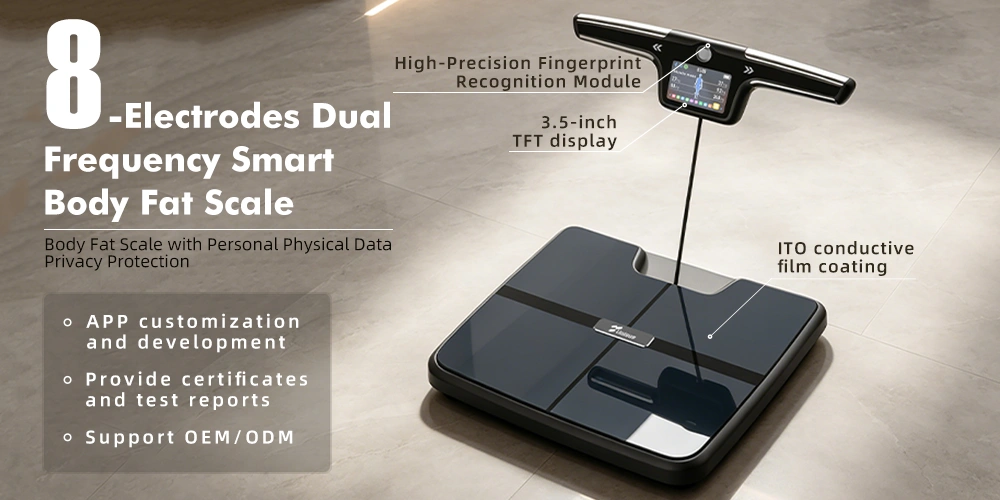
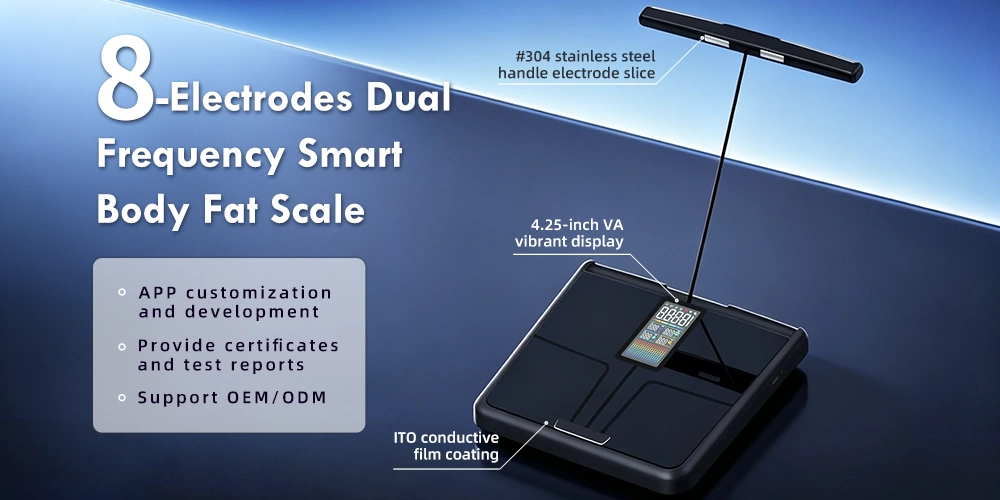
The 8-electrode body fat scale consists of 4 measuring electrodes on the surface and 4 handle electrodes. A safe and weak current can form multiple different closed-loop measurement paths.
The electrodes on the hands and feet can collect the electrical resistance data of various parts of the body. Depending on the hardware and BIA algorithm, the 8-electrode body fat scale is more suitable for measuring the entire body or segmental body composition analysis.
This configuration is commonly selected when the product requires:
- 4 electrodes on the handle + 4 electrodes on the surface
- Multiple safe current measurement paths
- Supports full-body measurement
- Supports segmental body composition analysis
- Higher hardware configuration, mostly used in high-end bioimpedance scales
The 8-electrode solution is mainly used in high-end body composition scales, fitness equipment, and health solutions, etc.
4-Electrode vs 8-Electrode Comparison
|
|
|
|
|
|
|
|
|
|
|
|
|
|
|
|
|
|
|
|
|
|
|
|
|
|
|
|
|
|
|
|
|
|
|
|
Which BIA Frequency Is Suitable for Your Product?
What Is Single-Frequency BIA?
Single-frequency BIA uses one electrical signal frequency to measure body impedance. It is commonly used in cost-sensitive and mass-market body fat scales.
What Is Multi-Frequency BIA?
The multi-band bioelectrical impedance BIA technology can use multiple different frequencies to collect human bioimpedance data and supports the calculation of more detailed body composition index analysis.
Why Does Measurement Frequency Matter?
Different measurement frequencies provide different impedance responses from body tissues and fluids. Using multiple frequencies can provide additional information for estimating body water and related compartments, depending on the measurement system and algorithm.
Which Frequency Technology Should Buyers Choose?
|
|
|
|
|
|
|
|
|
|
|
|
|
|
|
What Is Segmental Body Composition Analysis?
Segmented body composition analysis involves measuring different parts of the body separately, such as the left arm, torso, left leg, and right leg, to evaluate and analyze the composition index data of each part of the body.
How Do Electrodes Enable Segmental Measurement?
An 8-electrode configuration can create multiple measurement pathways, allowing the BIA system to collect impedance data from different body segments, depending on the hardware configuration and algorithm.
Who Needs Segmental Body Composition Analysis?
- Fitness equipment brands
- Major health and wellness brands
- Professional body composition products
- Advanced health monitoring products
- High-end chain gyms
Which Body Fat Scale Technology Should You Choose?
The choice of the technical solution mainly depends on your product positioning, target users, required functions and the connection requirements of the body fat scale.
For Entry-Level Body Fat Scales
If you are looking for a low-cost and mass-market smart scale, with a simple configuration, you can choose:
- 4 electrodes
- Basic bioelectrical impedance (BIA)
- 25 body composition indicators
- Affordable hardware
For Smart Body Fat Scales
The smart body fat scale combines BIA body composition measurement with various networking functions (WiFi and Bluetooth):
- BIA measurement technology
- Bluetooth/WiFi connection
- Support for multi-user management
- Can record, analyze and track data
- Integration with fitness apps and connected devices
For Premium Body Composition Scales
The high-end body composition analysis scale can be equipped with a more advanced measurement solution:
- 8 electrodes
- Advanced BIA technology (Bioelectrical Impedance Analysis)
- Supports segmented body composition measurement
- Capable of measuring 56-57 body composition data indicators
For Connected Health Platforms
If you need a body fat scale that can be integrated with the digital health ecosystem, please refer to the following configuration:
- Bluetooth
- Wi-Fi
- Mobile APP
- Supports cloud data synchronization
- Supports SDK/API interface integration, and can be connected to third-party systems
You need to consider your product positioning and target market, and then select the most suitable solution based on its functions.
Body Fat Scale Technology Buyer Checklist
Before selecting a body fat scale solution, the purchaser should conduct an assessment based on the following factors: Technology, Accuracy, Smart Features, and Supplier & Compliance.
Technology
- BIA technology
- Electrode configuration
- 4-electrode / 8-electrode
- BIA frequency
- Segmental analysis
Accuracy
- Calibration
- Repeatability
- Hardware consistency
- Validation of body fat algorithm
Smart Features
- Bluetooth connectivity
- WiFi connectivity
- Mobile App
- SDK/API integration
Supplier & Compliance
- OEM/ODM customization
- MOQ requirements
- Certifications
- Production capacity
- Quality control system
- Lead time
A good body fat scale solution should meet your measurement requirements, product positioning, connection needs, target market and purchasing demands.
FAQ
1.What Can Be Customized in an OEM/ODM Body Fat Scale?
We can tailor a unique body fat scale for your brand, market and product requirements.
- Hardware: 4 electrodes or 8 electrodes, sensor, display, shell material
- BIA and body fat algorithms: single frequency/multi-frequency measurement frequency, output 25-57 body composition metrics, calculation model
- Appearance design: brand logo, color, appearance ID, electrodes
- Connection method: Bluetooth, Wi-Fi, mobile app, SDK/API interface
- Packaging: outer box, manual, label
- Certification: compliant with the regulatory requirements of the target sales market
2.Why Choose an Experienced Body Fat Scale Technology Manufacturer?
An experienced smart body fat scale manufacturer not only provides finished products, but also brings many advantages:
- Mature BIA technology: Rich experience in body composition measurement and body fat algorithms;
- Supports OEM/ODM: Hardware, software, appearance, Bluetooth/WiFi, SDK/API can all be customized;
- Complete quality control: Stable and reliable production, calibration, and testing processes;
- Supports various certifications: Complies with different international market compliance requirements;
- Reliable supply: Production capacity, product quality, and delivery time can all be guaranteed.
Choosing a professional and highly skilled supplier can assist your body fat scale project throughout the process, from sample development to mass production.
3. What Certifications Should a Body Fat Scale Have for International Markets?
The certification requirements mainly depend on the target market and product configuration. Common certification requirements include:
- CE - for markets in Europe
- FCC - for markets in the United States
- RoHS – restriction of hazardous substances in electrical and electronic products
- UKCA - for markets in the United Kingdom
- BQB - for products with Bluetooth function
- KC - for markets in South Korea
If it is a networked or health-related product, additional tests and meeting corresponding compliance requirements may be necessary; for example, in the medical industry, medical-related certifications are required. Before manufacturing the product, you need to confirm the required certifications and choose a factory that meets the certification requirements of the target market for production.
4.Can Body Fat Scale Data Be Integrated With Third-Party Platforms?
Yes, it can be integrated. Connected body fat scales can connect the measured data to third-party platforms via Bluetooth, Wi-Fi, SDK or API.
Depending on the settings of the body fat scale, data such as weight, body fat percentage, muscle mass, body water content, etc., can be automatically synchronized to fitness apps, health platforms or other health management systems.
For customized project solutions, the purchaser needs to confirm with the factory in advance about the data format, communication protocol, SDK/API requirements and whether the platform is compatible.
5.How Can Body Fat Scale Measurements Be Made More Consistent?
The stability of body fat scale measurement data is related to product design and the actual measurement environment. Body fat scale manufacturers can enhance it through the following methods:
- Stable electrode contact, with good operation of hardware components
- Good quality of weighing sensors and BIA components
- Conducting calibration and various tests
- Using tested and verified body fat calculation algorithms
- Establishing standardized measurement operation procedures
- Ensuring the standardization of user parameter input
Conclusion
Unique Scales is a smart scale manufacturer with over 30 years of custom development experience, specializing in smart scales and body composition analysis solutions. Its main products include smart scales, body fat scales, fingerprint scales, solar-powered scales, and bioimpedance scales. These products are mainly used for home daily health management, global gyms, as well as various brands selling through ecommerce platforms such as Amazon and Shopify.
The right configuration depends on what the product needs to measure, how it will be positioned, and where it will be sold. A simple four-electrode design may be enough for one product, while another may require eight electrodes, more advanced BIA, wireless connectivity, or API integration.
In addition, whether it is a four-electrode body fat scale or a high-end eight-electrode body fat scale, we can help you develop the most suitable project configuration. If you are looking for a reliable body fat scale manufacturer, please submit your actual product requirements to obtain the corresponding custom solution.