
 Home
HomeBody Composition Scale: How Does It Work and What Importers Should Know Before Buying
 Aug 07,2026
 Unique Scales
Many body composition scales look similar from the outside, but their measurement performance can vary significantly. The differences mainly come from electrode design, BIA technology, body fat algorithms, and manufacturing processes. This guide explains the working principle of the body fat scale, clarify the actual differences between products, and help you select a bioelectrical impedance scale that suits your market needs. In addition, before placing an order, we will also assist you in reducing the risk of errors.
What Is a Body Composition Scale?
Definition of Body Composition Scale
A body composition scale is a smart weighing device that combines weight measurement with bioelectrical impedance analysis (BIA). It measures weight using a weighing sensor, collects electrical signals through electrodes, and finally combines body fat algorithms to estimate various body composition data indicators.
Through bioelectrical impedance technology (BIA) and data processing, in addition to measuring weight, it can also measure body fat percentage, muscle mass, body water content, BMI, heart rate, etc., a total of multiple body composition indicators.
What Can a Body Composition Scale Measure?
Different types and models of body fat scales can measure 25 to 57 body data indicators. Commonly included are:
- Weight
- Body fat percentage
- Muscle mass
- Body water percentage
- Bone mass
- BMI
- Basal Metabolic Rate (BMR)
- Level of visceral fat
- Heart rate
- Physical age
The measurement data and accuracy mainly depend on factors such as electrode design, BIA technology, algorithms, and product hardware configuration.
Body Composition Scale vs Traditional Weight Scale
|
|
|
|
|
|
|
|
|
|
|
|
|
|
|
|
|
|
|
|
|
|
|
|
Why Importers Should Understand Body Composition Scale Technology
Understanding the working principle of the body composition scale is beneficial for importers to make better purchasing decisions.
Evaluate Product Quality Before Purchasing
Before making the purchase, you need to first familiarize yourself with the core technologies of Smart Scale. Then you can evaluate the product quality, compare different models, and understand the reasons for the price differences among various suppliers.
Select the Right Product for Your Market
Reduce Product Risks
Understanding the technology behind body fat scales can help importers reduce product risks before large-scale purchases.
The quality of sensors, bioelectrical impedance (BIA) technology, algorithm performance, and production stability all directly affect user experience, customer complaints, product returns, and brand reputation.
Create Better Marketing Differentiation
Core technologies help importers establish a better product positioning in the target market.
For instance, BIA technology, 4-8 electrode design, APP interconnection and smart health data tracking functions, etc., can all serve as the core selling points of the brand.
How Does a Body Composition Scale Work?
The body composition scale is mainly composed of weighing sensors, electrodes, bioelectrical impedance (BIA) technology and body fat algorithms. It is used to collect body data and calculate multiple body composition indicators.
Step 1: Measuring Body Weight Through Load Cells
When you stand on the body fat scale, the weighing sensor will sense the pressure exerted on the scale surface, and then convert the pressure into an electrical signal. The smart body fat scale then processes these signals to calculate the user's weight.
The quality of the weighing sensor can affect the accuracy of weight measurement, the stability of the reading, and the reliability in long-term use.
Step 2: Collecting Body Signals Through Electrodes
After the weight measurement is completed, The electrodes send a safe low-level electrical current through the body and measure the impedance response from different tissues.
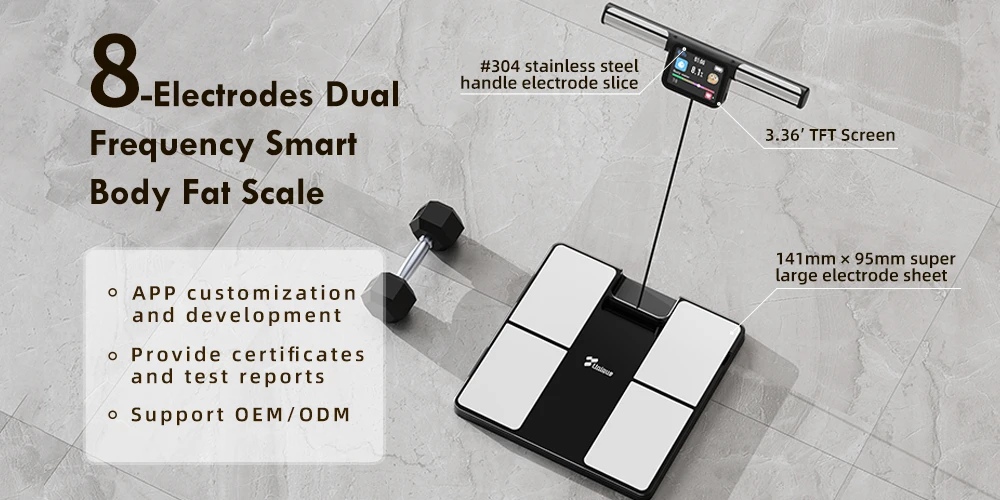
In an 8-electrode body composition scale, additional hand electrodes create a hand-to-foot measurement path, allowing the device to collect impedance data from different body segments for further analysis. At the same time, it detects the impedance data of different tissues in the body, which is used for subsequent calculation and analysis of data indicators.
The design of the number of electrodes determines the path of current measurement and the amount of body data collected. There are two schemes: 4 electrodes on the foot and 4 electrodes on the foot plus 4 electrodes on the handle.
Body fat scales with different numbers of electrodes are suitable for different markets. The 8-electrode body fat scale has higher accuracy than the 4-point body composition scale. Please choose the appropriate body fat scale according to your sales market.
Step 3: Measuring Bioelectrical Impedance (BIA)
Step 3: Measure bioelectrical impedance (BIA)
Bioelectrical impedance analysis (BIA) is the core technology used by body composition scales to calculate various components of the human body.
The smart scale sends a weak and safe current through the body and detects the flow of this current in various tissues of the body. Since the conductivity of different tissues in the human body is different, for example, muscles have a high water content and are more conductive; fat tissue generally has lower water content and higher impedance compared with muscle tissue.Therefore, the measured impedance values will also be different, which can be used to estimate the composition of the body.
Therefore, BIA results are estimates rather than direct measurements. The accuracy depends on electrode design, algorithms, user information, and measurement conditions.
The main electrical parameters measured by BIA are:
- Resistance (R): The obstruction of current by the body tissue.
- Reactance (Xc): The opposition caused by cell membranes and body tissues when electrical current passes through.
- Impedance (Z): The overall obstruction to the current combining resistance and reactance.
After the collected impedance data is processed in combination with the user's age, height, etc., and body fat algorithm, 25-57 estimated values such as body fat percentage, muscle mass, body water content, and heart rate can be calculated.
Step 4: Converting BIA Data into Body Composition Results
The impedance data collected by the BIA technology cannot directly provide body fat percentage, water content, and bone mass, etc. It needs to be processed in combination with the body fat algorithm to estimate various body composition indicators.
The body fat algorithm will analyze data from multiple sources:
- The electrical impedance data collected from the body
- Age
- Gender
- Height
- Weight
Based on the above information, the Bioimpedance Scale can estimate 25-57 various body composition indicators, such as:
- Body fat percentage
- Muscle mass
- Body water percentage
- BMI (Body Mass Index)
- BMR (Basal Metabolic Rate)
- Heart rate, etc.
The body fat algorithm model is one of the core technologies among various body composition scale manufacturers. Different data models, calculation methods and calibration methods will all affect the accuracy of the measurement results and the user experience.
This is also why two body composition scales using the same BIA technology may provide different results.
Step 5: Displaying Results Through APP and Cloud
After the body component data is calculated, the results will be displayed to the user through the connection of the mobile phone health APP and the cloud service, via Bluetooth or Wi-Fi. Users can view the measurement result values at any time, track the long-term data changes and analyses, and manage their own health records.
Depending on the configuration of the body fat scale, the APP and the cloud generally support the following functions:
- Multi-user management
- Viewing historical data records
- Automatic data synchronization
- Related functions such as analysis of health management data indicators
For importers, software capability is also an important factor when selecting smart body composition scales. Especially when it comes to customizing health APPs, firmware upgrades, or integrating with other health APP platforms.
What Technologies Affect How a Body Composition Scale Works?
Electrode Configuration: 4 Electrode vs 8 Electrode
The electrode configuration is one of the crucial factors that directly determine the way body data is collected by the body composition scale.
4 Electrode Body Composition Scale
The electrodes only measure the distance between the feet and the weighing platform. All four electrodes are on the weighing platform, and current is transmitted through the space between the user's feet to collect impedance data. Generally, 25 body data indicators can be measured.
The structure of the 4-electrode type is simple and its cost is lower. It is mostly used in entry-level body fat scales and is suitable for the mass consumer market with good value for money.
8 Electrode Body Composition Scale
In addition to the 4 electrodes on the surface, 4 more electrodes are added on the handle, forming an additional measurement circuit through the body.
It can simultaneously collect electrical signals from both hands and feet, enabling more comprehensive body data analysis. Depending on the model and technology configuration, some advanced body composition scales can provide up to 57 body composition indicators. It can be used in high-end body fat scales, Fitness Tracking Scales and other markets that focus on professional health.
For you, when choosing which electrode scheme to use, you cannot merely consider the number of electrodes. Instead, you need to take into account the target market, product positioning and customer needs to make the decision.
|
|
|
|
|
|
|
|
|
|
|
|
BIA Frequency Technology
The working frequency of BIA directly affects the amount of impedance data collected by the body composition scale.
Single Frequency BIA
It is a commonly used and cost-effective solution, mostly applied in consumer-level smart weighing scales.
Multi-frequency BIA
This method uses multiple different frequencies to collect more impedance data and is mainly used in high-end body composition scales.
Algorithm and Data Models
The BIA technology can only collect the raw impedance data. It also requires the body fat algorithm to convert these data into 25 to 57 items of body composition analysis data.
Different manufacturers of body fat scales employ different body fat calculation models, user databases and calibration methods, all of which can affect the consistency of the data and the user's experience.
Sensor Quality and Calibration Process
The quality of the hardware also affects the performance of the body fat scale, including:
- Weighing sensor quality
- Factory calibration
- Production inspection tests
These processes are beneficial for ensuring the stability and consistency of the performance of products from different production batches.
FAQ
1. What Should Importers Consider Before Purchasing Body Composition Scales?
Before the importer purchases the body fat scale, the following six factors should be taken into consideration:
Target market positioning: Based on your target customer group (daily household users, fitness enthusiasts, or professional health users), select the appropriate body fat scale.
Product features: View measurement function, whether it supports Bluetooth/Wi-Fi connection, APP compatibility, and match the actual needs of your local market.
Quality stability: Evaluate the quality of the weighing sensor, the factory calibration process, and the production inspection to ensure the consistency of performance for each batch of products.
Compliance certification: The smart scale products must meet the relevant certifications required by the target sales countries.
Supplier strength: It is necessary to assess the manufacturer's R&D capabilities, production capacity, quality control system, as well as its experience in foreign trade and export.
Customization capability: Verify whether the factory supports OEM/ODM customization solutions such as LOGO, appearance design, packaging, SDK and APP software.
2. How Do Body Composition Scale Manufacturers Ensure Measurement Accuracy?
The manufacturers of body fat scales ensure the stability of measurement results through factory calibration, various tests, algorithm debugging, and production control. These main aspects include:
Factory calibration: Adjust the weighing sensor and the entire measurement system to maintain the performance stability of the smart scale.
Testing: During the research and production stages of the smart scale, its product performance must be tested.
Algorithm verification: Optimize the calculation model to make the measured data fluctuate less.
Production control: By controlling the quality process, the performance gap between different batches of products can be narrowed.
By doing all these well, the measurement results of the body fat scale will be more stable and the user experience will be better.
3. Can Body Composition Scales Be Customized for Different Brands?
Yes. As a manufacturer of body composition scales, we can support OEM/ODM customization requirements of different brands. This includes:
Product ID, logo, packaging gift box, color, ITO/electrode slice, APP, UI interface, firmware, instruction label, screen, API/SDK compatibility, and other customized solutions.
4.What Should Importers Evaluate Before Choosing a Body Composition Scale Supplier?
When choosing a supplier for body composition analyzers, you should not only compare prices, but also evaluate the technical capabilities, production experience, customization ability and various compliance certifications of the factory.
Key points to be evaluated:
- Technical strength: Verify the BIA technology of the manufacturer, the development capability of body fat algorithms, and the compatibility of the APP/software.
- Production capabilities: Evaluate the factory's experience, production capacity, quality control system, and the stability of production performance.
- OEM/ODM customization capability: Verify whether the supplier supports customization services such as product ID design, packaging, APP customization, and SDK/API interface integration.
- Certification compliance: Verify whether the product has relevant certificates that comply with international standards such as CE, FCC, RoHS, ISO9001 and ISO13485.
Selecting suppliers with strong technical and production capabilities can significantly help you reduce product risks and enhance market competitiveness.
5.What markets is your body composition scale generally applicable to?
Our smart body composition scale is mostly used for:
- Daily home body management
- Offline store retail
- Gymnasium
- Health management facility.
Conclusion
Unique Scales is a professional manufacturer specializing in smart weighing scales and body composition solutions, with over 30 years of manufacturing experience. The company mainly produces smart weighing scales, body fat scales, fingerprint scales, solar-powered scales, and bioimpedance scales. These are mainly used for daily home health management, global gyms, as well as various brand merchants such as independent stores, Shopify, and Amazon. Understanding how a body composition scale works helps importers evaluate products beyond appearance and price. Factors such as BIA technology, electrode design, algorithm capability, production stability, and supplier experience all influence the final product performance. Only by choosing the appropriate products for the target market can the procurement risks be reduced and more competitive products be made. In addition, we also provide customized processing for Fortune 500 companies. If you are looking for a reliable manufacturer of body composition scales, please come for consultation. We provide OEM/ODM solutions, production support, and customized body composition scale solutions for global brands