
 Home
HomeBioelectrical Impedance Analysis (BIA) in Body Fat Scales: Accuracy, Technology, and Buyer’s Guide for Importers
 Jun 27,2026
 Unique Scales
Bioelectrical impedance analysis (BIA) is the core detection technology used in the smart weighing scale market worldwide. For importers and brand owners, BIA is not only a measurement method, but also determines the positioning, accuracy level of body fat scales, as well as the user experience for end consumers. The measurement accuracy can also vary significantly depending on the hardware configuration, the quality of the body fat algorithm, the water content of the human body, and the usage habits. In this article today, we will thoroughly explain the measurement methods and accuracy of BIA, thereby helping you reduce your return rate.
What is BIA
BIA is a bioelectrical impedance analysis technology applied to body fat scales. It estimates and analyzes body fat content and various body health indicators based on the electrical resistance generated by the weak current in the human body.
Due to the different electrical conductivity of fat, muscle and water, the built-in algorithm of the body fat scale can estimate your body composition. Therefore, BIA is the core measurement principle that determines the accuracy, data stability and product positioning of the body fat scale.
It should be noted that the BIA can only measure electrical impedance and cannot directly determine the weight of fat or water content. These data can only be estimated values and cannot be regarded as direct medical diagnostic evidence.
Why BIA is used in body fat scales
- The BIA (Bioelectrical Impedance Analysis) technology has the highest overall cost-performance ratio among various measurement methods, and thus is widely used in body fat scales.
- Compared with medical-grade technologies such as DEXA, the BIA system is much cheaper and does not require bulky and complex equipment. It is suitable for mass production of smart body fat scales and other products.
- BIA can measure in real time and quickly, and all data can be obtained within a few seconds, significantly enhancing the daily weighing experience.
- For factories and OEM customers, the hardware can be made small and lightweight, with controllable production costs. The BIA technology is highly adaptable and easy to be used as a contract manufacturer.
How BIA works
BIA (Bioelectrical Impedance Analysis) is based on the principle that the electrical conductivity of fat, muscle and water is different.
When the user is measuring the weight, the electrodes on the scale will release a weak alternating current through the human body. The resistance values of the electrical currents produced by different human tissues vary. Lean meat tissues with higher water content and electrolyte ratios have better conductivity; while fat tissues are less conductive and require a greater resistance value.
After the smart body fat scale measures the electrical resistance value, it combines with the body fat algorithm to calculate 25 to 57 body data indicators such as body fat percentage, muscle mass, body water content and heart rate.
Therefore, BIA is merely an estimation technique based on the analysis of electrical signals, and it does not directly and precisely measure the actual physical quantities of fat and muscle.
Types of BIA technology
Bioelectrical impedance technology (BIA) is classified into three major categories based on the number of electrodes, measurement frequency, and measurement method. Each type directly determines the accuracy, application scope, and market positioning of the body composition analyzer.
1.Electrode configuration
The number of electrodes determines the way current is transmitted through the human body and the effectiveness of data collection, directly affecting the stability of the measurement.
- 2 Electrode: This is the most basic electrode configuration. The electrode is responsible for both outputting current and collecting signals. It is mostly used in lower-end entry-level body fat scales, with limited measurement accuracy and significant differences in accuracy.
- 4 Electrodes: This is the most commonly used configuration in smart scales on the market. It operates the current electrode and voltage electrode separately, effectively reducing interference and thereby improving the stability and accuracy of the measurement.
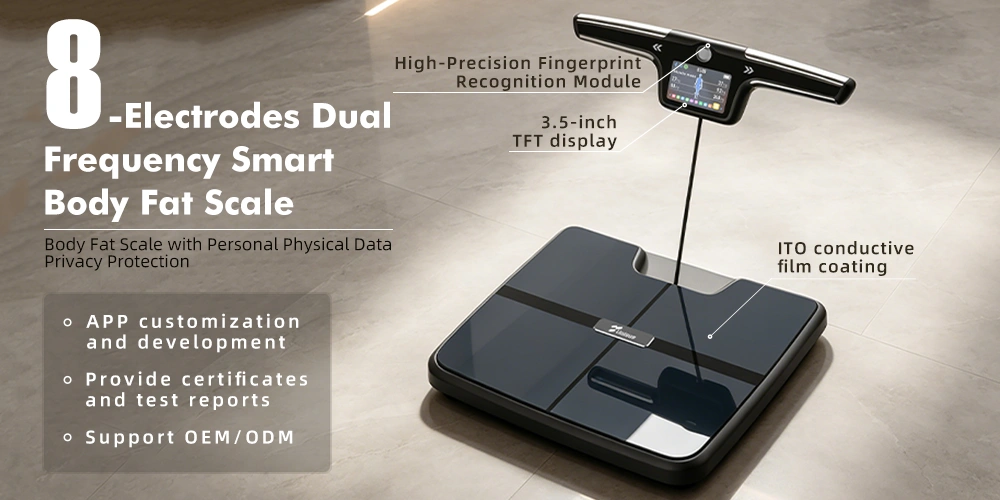
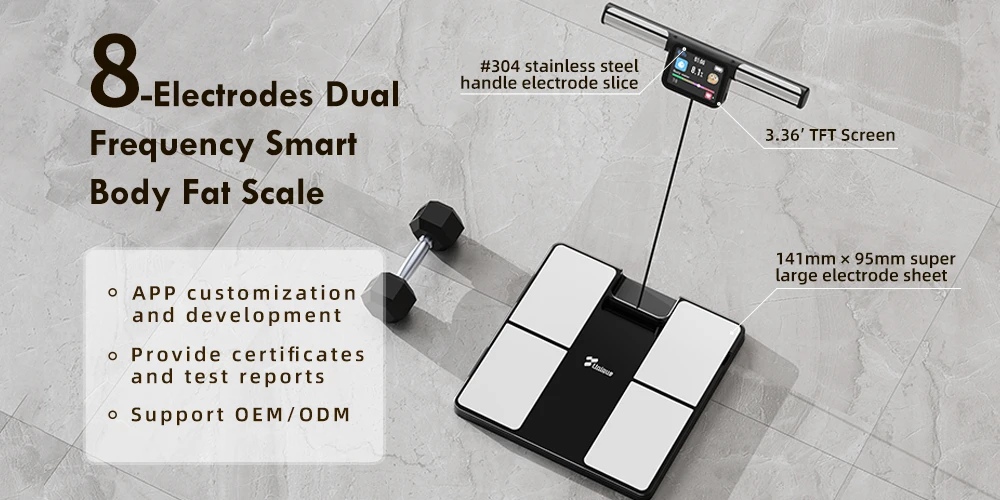
- 8 Electrodes: High-end professional-grade electrode configuration, capable of measuring data for each part of the upper and lower body separately. It is commonly used in professional fitness equipment and high-end bioimpedance scales, allowing for more detailed and comprehensive body composition analysis.
2. Measurement of frequency
The measurement frequency of the electrical signal directly affects the depth to which the current penetrates the human tissue.
- Single-frequency BIA: This method involves the use of a single fixed-frequency current for detection. It has a simple structure and low cost, and is mostly used in ordinary household body fat scales. It can only provide an overall estimation of human body composition, and its accuracy is relatively low.
- Multi-frequency BIA: Utilizing two or more frequencies to measure the water content within and outside cells, this method offers higher data accuracy and finer analysis dimensions, making it the core technology of high-end body fat scales.
3. Measurement Range
BIA can also be classified into two types based on the different body measurement ranges: full-body measurement and segmented measurement.
- Whole-body measurement: The weak current output from the weighing platform when the body is standing on both feet is used to measure the overall impedance, and it is commonly used in 4-point body composition scales.
- Segmented measurement: It can measure various body parts such as the arms, legs and trunk separately. It can precisely analyze the distribution of muscles and fat in specific areas, providing more accurate data. It is mostly used in professional body fat analyzer scales.
However, greater accuracy comes at the cost of higher costs and complexity.
Why do the BIA test results from different body fat scales vary?
Due to the differences in the configuration of the body fat scale, the body fat algorithm, and the user's usage conditions, the BIA measurement results will also vary. These differences do not indicate any quality issues with the WiFi smart scale; rather, this current detection technology is inherently susceptible to various conditions.
The main factors that affect data deviation include:
- Number of electrodes: Double electrode, four electrodes, segmented eight electrodes (the more electrodes, the higher the measurement accuracy).
- Body fat calculation algorithm: The body composition algorithms developed by each brand based on different population models are different.
- Measurement frequency: Single frequency, dual frequency, multi-frequency (the more frequencies, the higher the measurement accuracy).
- Fluctuations in the body's own state: Changes in body water content, after exercise, before and after dinner, and measurements taken at different times of the day can all affect the measurement results.
For you, when evaluating the accuracy and market positioning of the smart Bluetooth scale, it is essential to be aware of these influencing factors. Only then can you make a reasonable judgment on the product's precision and properly position the product.
What affects BIA accuracy
The accuracy of bioelectrical impedance analysis (BIA) is mainly influenced by three factors: the hardware equipment, the body fat algorithm, and the user's own condition.
- Hardware equipment: The quality of electrodes, the stability of signals, and the precision of chips all can interfere with current detection, resulting in data deviations.
- Body fat algorithm: Different population data models, calibration methods and data training samples vary. Even for the same person, the measurement results obtained on different smart scales may also differ.
- User's own condition: The amount of water intake, before and after exercise, as well as the measurement time may all affect the impedance reading.
BIA vs other body composition methods
BIA usually compares itself with other body composition measurement methods in terms of accuracy, cost and ease of use.
- BIA and BMI
BMI only measures height and weight; while BIA can estimate more comprehensive 25-57 body data indicators such as fat, muscle, body water content and heart rate.
- BIA and DEXA
DEXA has the highest measurement accuracy but is expensive and not suitable for daily use by users; BIA has a high cost-performance ratio and is suitable for both household and commercial applications.
- BIA and skinfold calipers
Skinfold calipers can only be measured manually; while BIA can provide faster and more standardized measurement results.
Common misconceptions about BIA
There are three common misunderstandings regarding Bioelectrical Impedance Analysis (BIA):
- BIA is not accurate. BIA is not a medical diagnostic tool; it is merely a method for estimating body data based on electrical impedance. Under consistent conditions, its measurement results are usually reliable.
- Different readings mean that the bioimpedance scale is defective. Small fluctuations in each measurement are normal and can be caused by changes in body moisture content, measurement time, or changes in the user's body condition. They are not faults of the smart scale.
- The measured data must be exactly the same as that of professional medical equipment. Home BIA body fat scales are only for users to monitor body changes and observe long-term health trends. They cannot be compared with professional medical equipment data or used as clinical diagnostic evidence.
Buyer’s guide for BIA body fat scales
When purchasing the BIA smart body fat scale, you should focus on the 4 key factors that directly affect the product performance and market acceptance.
- Performance Stability
The stability across batches should be uniform. It should have a built-in calibration function to reduce the return rate and customer complaint rate, especially on e-commerce channels such as Amazon.For most importers, consistency is more important than absolute accuracy.
- Hardware Quality
The electrode design and sensor accuracy directly affect the reliability of the measurement data and the user experience.For Amazon sellers, batch stability is more important than advanced features.
- Body Fat Algorithm
Check if the manufacturer's body fat algorithm supports customization and is compatible with different regional populations (Europe, the United States, Asia, and maintains consistent accuracy with the user group.
- Compliance Certification
Ensure that the body fat scale complies with the required certifications for the target market before shipment, such as CE, RoHS, and FCC. Avoid risks such as being detained, removed from shelves, and fines.
How to choose a BIA body fat scale manufacturer
When you are selecting a BIA body fat scale manufacturer, you should focus on the following 4 factors.
- Production Capacity: Ensure that the factory can support stable actual production and timely delivery, avoiding stockouts that delay sales.
- Body Fat Algorithm Capability: Check if the factory can adjust the algorithm independently to adapt to different markets for developing or customizing BIA algorithms.
- Consistent Quality: Ensure stable performance across batches, with built-in calibration functions, reducing the cost of returns and complaints.
- OEM/ODM: Confirm that it supports comprehensive customization services, including brand logos, packaging, colors, SDK, API, etc.
FAQ
1.The core application fields of BIA technology
Bioelectrical impedance (BIA) is a rapid method for measuring the body composition of humans, and it is mainly applied in:
- Home smart body fat scale: Monitoring data for daily weight loss and fitness activities of ordinary people;
- Fitness tracking scale: A tool designed for fitness enthusiasts to monitor and track their training progress and physical changes.
- High-end medical body composition analyzer: Used in medical institutions for in-depth health assessment and monitoring.
2.What is the difference between segmental and whole-body BIA?
- Whole-body BIA: The electrical impedance resistance of the lower body is measured by four electrodes on the body surface, while the body composition data of the upper body is estimated from 25 body parameters, with moderate accuracy.
- Segmentation BIA: Eight electrode segments are placed on the upper and lower body to measure the entire body. The electrical resistance of the limbs and the trunk are separately measured, enabling the breakdown of 57 body data including muscles, fat, etc. for each part. The measurement results are more detailed and accurate.
3.What are the limitations of BIA technology in body fat scales?
- The measurement results are prone to be affected by factors such as drinking water, exercise, eating, and different measurement times, and the measured values fluctuate greatly.
- All the data results are estimated and cannot be used as professional medical test results.
- Different smart scales have different body fat calculation algorithms. Even for the same person, the data measured on different smart scales will also be different.
4.What is the difference between 4-electrode and 8-electrode BIA?
- 4 Electrodes: Only using 4 electrodes on the sole of the foot, it measures the impedance of the lower body only. The data indicators for the upper body (such as body composition) can only be roughly calculated, with relatively low accuracy.
- 8 Electrodes: 4 electrodes on the sole of the foot, plus 4 electrodes held by both hands, can separately measure the upper limbs, lower limbs, and trunk. It can also measure the impedance of the entire body separately, and the measurement accuracy is higher.
5.Is BIA safe?
The BIA measurement is safe and suitable for our regular repeated measurements.
When used, it only outputs a weak current through the human body, which is completely imperceptible and will not cause any harm or interfere with normal bodily functions.
Conclusion
The products of Unique Scales include intelligent weighing scales, body fat scales, fingerprint scales, solar-powered scales and body composition analyzers, which are applied in daily home health management, global gyms, and brands such as Amazon/Shopify. Our body fat meter adopts bioelectrical impedance analysis (BIA) technology, featuring over 40 body fat algorithms, built-in calibration function, and ensuring consistency between batches; its correlation with DEXA can reach 98.7%. We can provide customized solutions such as appearance, SDK/API/user interface/software development kit/application mini-program. We also undertake OEM production for Fortune 500 companies. If you need, please contact us promptly and request an OEM quote based on BIA technology configuration.