
 Home
HomeBody Fat Percentage Chart: Understanding Body Composition, BIA Measurement, and Accuracy Differences
 Jun 23,2026
 Unique Scales
The body fat percentage chart is merely a reference system that can categorize body fat levels based on population data. It is commonly used to interpret the body composition measurements obtained from smart body fat scales and other measuring tools. It cannot be used as a medical diagnostic tool but can only serve as a reference guide for understanding the general range of body fat. In this article today, we will provide a detailed explanation on how to utilize body composition data and measurement methods to understand and interpret body fat percentage charts.
What Is a Body Fat Percentage Chart?
The body fat percentage chart serves as a universal reference standard. Based on the physical data of a large number of people, it divides body fat content into different ranges, allowing individuals to visually determine which level their fat percentage falls into - whether it is in the healthy, fitness, or overweight range.
Charts are generally divided into five categories of fat standards: basic essential fats, athlete type, fitness population type, general public type, and obese type. These classifications are mainly used for general interpretation and should not be regarded as the basis for professional medical diagnosis.
Body composition is a necessary foundation for interpreting body fat percentage charts. It is usually used in conjunction with intelligent body fat scales (such as bioelectrical impedance scales BIA) to help users understand their measured body composition data in a simple and intuitive way.
Body Fat Percentage Chart (Male vs Women)
|
|
|
|
|
|
|
|
|
|
|
|
|
|
|
|
|
|
|
|
|
|
|
|
As one ages, even if body weight remains stable, the body fat percentage within the body will increase. The main reason for this is that the amount of muscle in the body decreases and the metabolism slows down, causing a change in the way the body stores energy, and thus the body fat percentage rises.
What Is Body Composition?
Body composition refers to the proportion of various components in the human body by weight. It mainly consists of four items:
- Fat weight: Total body fat, including basic essential fat and excess accumulated fat
- Muscle mass: Total weight of all muscles in the body, determining physical strength and athletic ability
- Body water: All the fluids in the body, ensuring normal metabolism of the body
- Lean body mass: All the body tissues excluding fat, including muscles, bones, internal organs, and water.
Why Body Fat Percentage Matters?
Body fat percentage can truly reflect our physical condition, allowing us to see the proportion of fat in our body. It is a crucial data for assessing physical health, measuring body composition and evaluating health status. The body fat percentage chart is commonly used to assess these health indicators.Can be used for:
- Health Monitoring: Determine if body fat is within a healthy range to avoid potential health risks associated with excessive fat.
- Fitness tracking: Used to monitor fat loss and muscle gain, to assess the effectiveness of training.
- Body composition analysis: This method is used to separate the weight of fat from the lean body mass such as muscles and bones, allowing you to clearly understand your true body composition.
How to Read Body Fat Percentage Correctly
To determine body fat percentage, one must refer to long-term tracking data rather than relying solely on a single measurement.
To accurately read the body fat percentage data, remember the following points:
- Focus on long-term trends: Analyze the changes in comparative values over several consecutive weeks or months, and avoid focusing on the minor fluctuations each day.
- Avoid daily comparisons: The body fat percentage figures may vary from day to day due to factors such as the amount of water consumed, meal times, and the timing of the measurement.
- Fixing one smart body fat scale for measurement: Always use the same smart weight scale to ensure consistent measurement results.
Why Body Fat Percentage Changes
It is normal for the body fat percentage value to fluctuate. It is not necessarily because the smart scale is inaccurate. There are four factors in daily life that can affect its readings.
The main points are as follows:
- Water intake: Changes in water intake in the body may interfere with the body fat measurement results;
- Diet and exercise: After eating or exercising recently, the body fat measurement results will also have temporary fluctuations;
- Measurement time: The measurement times in the morning and evening are different, and the measured body fat values themselves have differences;
- Body fat scale differences: Different body fat scales have different calculation algorithms, and the measured values will have deviations.
How Body Fat Is Estimated
The body fat scale cannot directly measure the body fat content. Instead, it estimates the figure through the bioelectrical impedance analysis (BIA) method.
- Measuring impedance with a weak current: The smart body fat scale uses electrodes on the scale surface and the handle to release a weak current through the body. Combined with BIA technology, it determines the body composition based on the resistance of the current.
- Water content affects the results: The water content in muscles is much higher than that in fat. The amount of water in the body also changes the resistance value, which in turn indirectly affects the calculated results.
- Estimating body fat based on comprehensive data: The body fat system takes into account your gender, age, height, weight, and combines it with population data formulas to finally calculate your body fat percentage.
How to Get Your Body Fat Percentage?
How to calculate your body fat percentage?
At present, there are mainly three common methods for measuring body fat:
- Gym equipment testing: Many gyms offer professional body composition analyzers. Users can quickly calculate 57 data indicators such as body fat, muscle mass, and water content simply by standing on the device, which is suitable for daily fitness reference.
- DEXA Scan: DEXA (Dual-energy X-ray Absorptiometry) is regarded as the most accurate detection method and is mostly used in medical or professional settings.
- The intelligent body fat scale utilizes BIA (Bioelectrical Impedance Analysis) technology to enable at-home self-measurement and estimation of body fat content. The operation is simple and convenient, but the data obtained is only an estimation and cannot be regarded as a precise measurement.
How can exporters choose the appropriate body fat scale?
Select the model based on the sales market, the target user group and the precision requirements:
- Daily household use: Optional 4-point body composition scale, capable of measuring 25 body-related data, suitable for daily home monitoring.
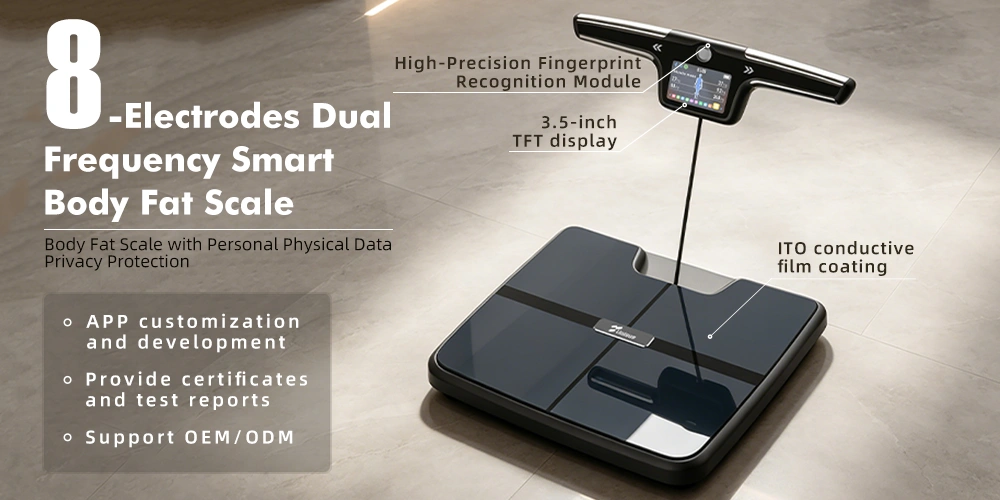
- Gym: Optional 8-electrode body fat scale, capable of measuring 57 body indicators, suitable for fitness enthusiasts to track fat loss and muscle gain.
- Hospital and pharmacy professional facilities: Optional bioimpedance scale, with higher measurement accuracy and more comprehensive body composition data.
- Purchasing wholesaler: The smart scale should support customized solutions, and also need to consider its stability, consistency and quality control.
FAQ
1.What is BIA technology?
BIA stands for Bioelectrical Impedance Analysis. It is a method that estimates body composition by using a weak current in the human body.
The smart scale will release a weak electric current that is imperceptible to the human body. Because the conductive abilities of fat, muscle and water are different, the body fat scale calculates body fat, muscle and water content and other body data based on the electrical resistance data generated by the weak current.
2.What are the differences between the 4-electrode and the 8-electrode?
The main difference lies in the measurement range and the level of data accuracy.
1)The electrode model can only directly contact the four electrodes on the sole of the foot through the scale surface. A weak current is detected through the lower body, while the body data indicators of the upper body can only be estimated. It can measure 25 data indicators and is suitable for daily use in ordinary households.
2)The 8-electrode model features electrodes on the scale surface and on both hands. It enables simultaneous measurement of the upper and lower body, and can separately estimate the distribution of fat and muscle in the upper and lower parts of the body. It can measure 57 data indicators, and the data is more comprehensive and stable.
Overall, the 8-electrode body fat scale has higher measurement accuracy and provides more comprehensive body composition data analysis.
3.Why Different Body Fat Scale Show Different Results
The results obtained by different methods for measuring body fat are different, because the body fat percentage is not directly measured but calculated based on body fat algorithms. The main reasons are as follows:
- Different body fat algorithms: Each smart body fat scale uses a different formula for calculating body fat percentage, and the resulting body fat rate figures will also vary.
- Different population models: When calculating body fat, the scale takes into account different population samples, and then makes estimations based on factors such as age, gender, and body type. Due to the different bases, the final calculation results will also vary.
4.How accurate is a body fat percentage chart?
The body fat percentage chart is not a measurement tool; rather, it is a reference system based on population data, which can be used to help classify the levels of body fat percentage.
Its accuracy depends on the body fat measurement algorithm. Different body fat scales have different body fat algorithms, and thus the measurement results will also vary.
The body fat percentage chart serves as the best overall reference for understanding the trend of body composition, but it is not an exact medical measurement.
5.Can body fat percentage charts be used for health diagnosis?
The body fat percentage chart cannot be used for medical diagnosis.
It is merely a general reference standard based on population data and can only simply distinguish fat levels. It is not a professional clinical test and cannot determine diseases or physical conditions of the body.
For a formal health diagnosis, professional medical examinations such as DEXA scans and blood tests are required. The body fat percentage chart is only suitable for general people for daily reference, to understand and track changes in body fat and other fitness indicators, thereby enhancing personal health awareness.
Conclusion
Unique Scales has designed products such as intelligent weighing scales, body fat scales, fingerprint scales, solar-powered scales and body composition analyzers. These products are applied in daily home health management, global gyms, medical health monitoring, and brands like Amazon/Shopify. Our body fat scale has over 40 body fat algorithms, capable of measuring 25 to 57 body data indicators such as body fat percentage, water content and heart rate. The DEXA correlation of the body composition scale can reach 98.7%. We also provide comprehensive customization solutions, including appearance, Bluetooth, wireless network, user interface, software development kit, and application mini-programs. If needed, please contact us promptly.